Errand Exhaustion Is Real: What Big-Box Stores and Airports Do to Your Brain
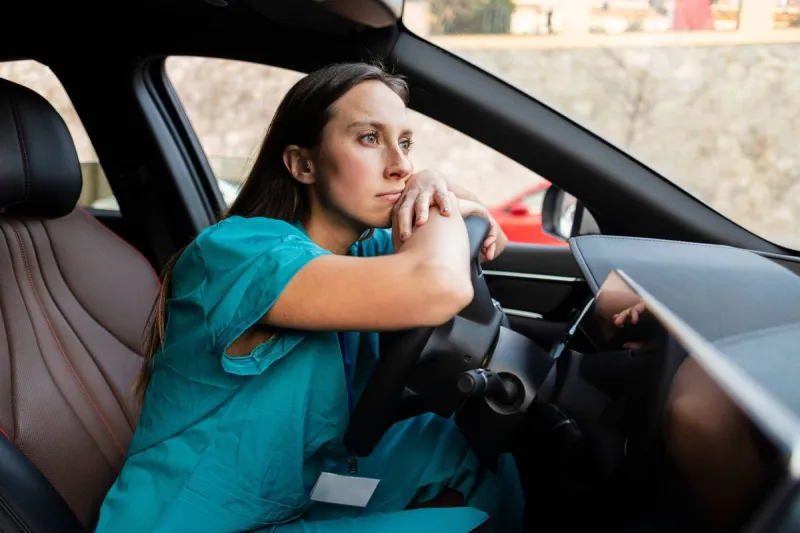
Photo: tired shopper sitting in car parking lot decompressing, via i2-prod.mirror.co.uk
You went in for paper towels. You came out feeling like you'd been through a washing machine. If routine errands — the warehouse club, the airport terminal, the DMV waiting room — leave you oddly destroyed while everyone around you seems fine, you're not being dramatic. You're experiencing a very specific kind of acoustic overload that some brains absorb far more than others.
Let's take apart why these places hit so hard.
The Anatomy of an Overwhelming Space
Big-box stores and airports aren't loud the way a concert is loud. They're loud in a sneakier, more exhausting way — a stack of separate stressors:
- Fluorescent buzz. That faint 60-hertz hum from overhead lighting and ballasts sits right in the range your hearing is most sensitive to. You may not consciously notice it, but your auditory system never stops processing it.
- Cavernous ceilings. High, hard, unfinished surfaces turn every footstep, cart wheel, and PA announcement into a reverberant smear. Echoey spaces force your brain to work overtime separating speech from reverb — a job it does automatically and invisibly, until it burns you out.
- Overhead announcements. The periodic page — "cleanup in aisle 14," "final boarding for flight 2281" — is designed to cut through everything. Your attention system obeys. You can't not listen, which means you get yanked out of your own head dozens of times per visit.
- Cart rattle and beeping. Narrow-band, metallic, repetitive sounds — cart wheels, register beeps, scanner guns — are the acoustic equivalent of a ticking clock in the next room. Small, but relentless.
Stack all of that on top of visual clutter, decision fatigue, and crowds, and you've got an environment that quietly drains anyone — and flattens people with sensitive nervous systems.
Why It Wrecks Some People More Than Others
There's real variability here. Some brains filter background noise efficiently; others process nearly everything at full priority. Stress, sleep debt, and conditions like sensory processing sensitivity all turn the filter down further. So the same Costco run can be a mild annoyance for your shopping partner and a system-wide drain for you. Neither of you is wrong. Your hardware is just different.
Your Sensory Survival Kit
You don't have to white-knuckle it. A little preparation changes the whole experience:
- Carry discreet earplugs. High-fidelity filter earplugs (the kind musicians wear) take the edge off the buzz and echo while letting you still hear a cashier. A simple foam pair works too — even partial dampening lowers the load.
- Go off-peak. A Tuesday morning errand is a different acoustic planet than a Saturday afternoon. If your schedule allows, this is the single biggest upgrade.
- Plan one micro-escape. Know where the quiet pockets are — the outdoor pickup counter, a bench near the exit, the car itself. Stepping out for two minutes mid-trip resets more than you'd expect.
- Do one thing, not five. Errand-stacking multiplies exposure time. Split trips when you can.
The Ten-Minute Car Decompress
Here's the step most people skip — and it's the one that keeps the overload from following you home. Before you drive off:
- Sit in the parked car. Engine off, or on with the AC if it's hot.
- Put on earplugs or headphones with nothing playing — just dampened silence.
- Breathe slowly for about ten breaths, then let your shoulders drop away from your ears.
- When you feel your body unclench — usually five to ten minutes — drive home in whatever silence you need. Radio off is allowed.
That short buffer lets your nervous system discharge the accumulated load in the parking lot instead of unloading it on your family at the door. The errands still happened. The wrecked-evening aftermath doesn't have to.